First Settlers
The first settlers in what is now Putnam County came in the decade beginning with 1830. Who was the first to come is a matter of dispute. John Corneilison and his daughter, Hannah Vincent, settled in the county in March, 1836.
Brightwell Martin is said by some to have come earlier than this. Settlers who preceded these were Spencer Grogan, William Miunix, Thomas Eelly, James Cochran, Thomas Wright and Jack Martin. The dates of their coming are unknown. Of the early settlers the largest number came either from some other part of Missouri or from Kentucky. Virginia, Tennessee, Ohio and Illinois were also represented in the population of the county during its early history. Later, immigration from the northern part of the United States came in larger numbers.
Besides the nine persons mentioned above, the following were among the early settlers in Putnam County.
| Came before 1840 | ||
| Lilburn Smith Joshua Shaddon Joseph Shaddon |
John Shaddon William Loe Col. James Wells |
G. W. R. Ledford Elias Ledford Jesse Trewhitt |
| Came in 1840 | ||
| S. P. Kirby James G. Humphreys Hamilton W. Berry Mary M. Johnson |
John J. Brasfield Martha J. Fullerton Joshua Guffey W. R. Berry |
Charles T. Berry John Bragg W. A. Smith Bennett West |
| Came in 1841 | ||
| Elias Morgan Peter Nicholas Richard West Daniel Sparks James Ryals |
Wilson Lee James M Brasfield R. M. Shaddon Hiram Perkins F. K. McCollom |
John A. McCollom A. Q. McCollom Lucy Smith William Kirby John Ryals |
| Came in 1842 | ||
| Samuel Marshall John Williams |
J. M. Gilstrap William P. Shanklin |
Branch Morris |
| Came in 1843 | ||
| Samuel West Thomas Holman Robert Smith |
Joseph Guffey John F. Crabtree Wesley Crabtree |
William J. Cook James Shaw |
The exact date of their arrival has not been ascertained. Immigrants in large numbers continued to come up to the time of the Civil War.
The early
settlers made their homes in different parts of the county. St.
John, in the northwestern part; Medicine Creek, in the south
western part; Putnamville, which was the county seat for a time;
and the Mullines settlement in the southeastern part of the
county, these were early settlements within the borders of what
is now Putnam County.
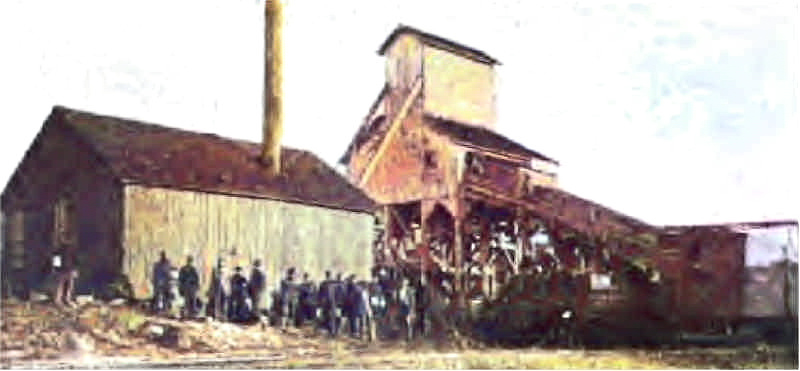
Putman County Coal Mine
The early settlers did not, as a rule, enter their land. The office of entry was at Fayette, in Howard County, about 100 miles away, and journeys there had to be made overland. There were few entries made before 1849, in which year a land office was opened at Milan, now the county seat of Sullivan County, which adjoins Putnam on the south. Entries from that time on were numerous. Entries for land in Putnam County were first made in 1836. Brightwell Martin made the first entry, on April 24th. Several residents of adjoining counties entered land in Putnam County during the next few years.
The early settlers found the valleys partly or entirely covered with timber. Fences were rare and the settlers held their lands almost in common. Their cattle, sheep, hogs and horses ranged at will.
Pioneer Life
Poor but honest, the early settlers had the proverbial hospitality of the South. Strangers were cordially entertained and the people were kindly toward each other. The market was far distant, so they produced little that they did not consume themselves. Then too, the "good roads movement" had not begun to be agitated and the roads and bridges were very bad. Deer and wild turkeys were common and fish were found in the streams. These could be gotten with little effort and helped to supply the wants of the settlers. The women spun, wove and made clothing for the family. Tobacco was raised at home and whisky was plentiful at only fifteen cents a gallon. On election days, this intoxicant was often given away free to influence the voters.
The nearest markets were Brunswick, on the Missouri river, seventy-five miles distant, almost due south; and Alexandria, on the Mississippi, eighty miles to the eastward. Bad roads made it impossible, usually, to make the trip in less than eight or ten days. The early settlers did not commonly travel for pleasure. The trips were tedious and it was hard to get the "ready money" which was necessary on the journey. Little that the pioneer had could be converted into cash except with great difficulty. Even the most prosperous financially had trouble getting funds.
These features of the early life in the
county were not unlike those of life elsewhere in Northeast
Missouri. The pioneers were much the same in manners and customs.